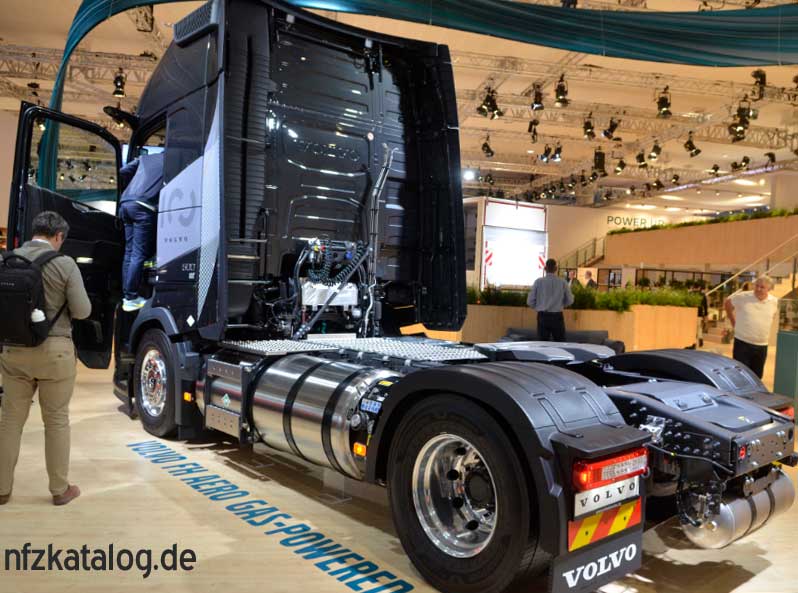



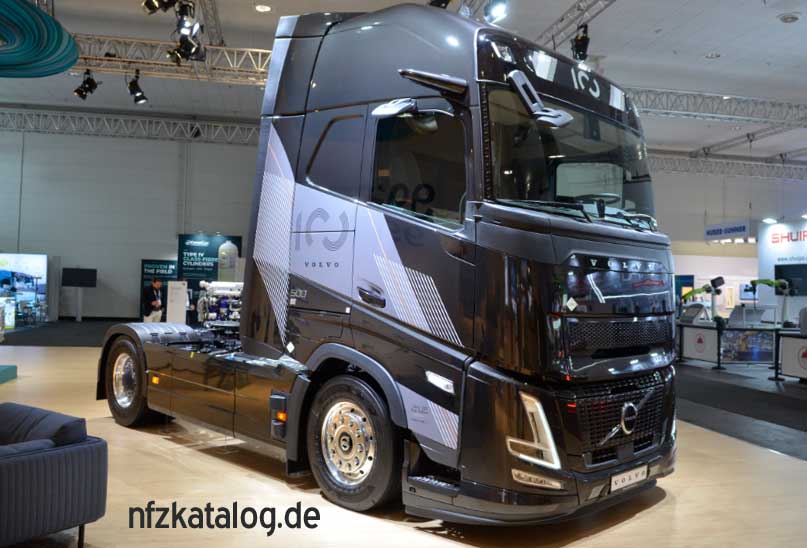
Volvo Trucks FH 500 Aero LNG — 4×2 tractor unit. A semi-truck with an output of 375 kW / 500 hp, running on (bio-)LNG. According to Volvo, it offers a strong business case.
For long-haul transport, a truck equipped with an LNG engine currently presents a compelling business case compared to other powertrains, Volvo Trucks states in its communications to transport operators. An LNG-powered truck can serve as a suitable interim solution for the coming years—particularly in cases where an electric truck is not yet a viable option for various reasons. At the IAA Transportation trade fair in Hanover two months ago, Volvo Trucks showcased its newly developed gas engine (G13), featured in an FH500 Aero 4×2 tractor unit (pictured here in a special anniversary edition).
What is LNG, and why is this fuel such an attractive option for a truck?
LNG stands for Liquefied Natural Gas—natural gas that has been converted into a liquid state through cooling. LNG is available at various filling stations (check the map) and is stored in cylindrical tanks. Refueling is just as fast as it is for a diesel truck, though drivers are required to wear personal protective equipment (PPE) during the process.
Bio-LNG is a variant of LNG. It is produced locally from organic waste, making its combustion CO2-neutral. While CO2 is still emitted, this carbon was previously captured from the atmosphere by plants. Volvo points out that transport operators can achieve a 100% reduction in CO2 emissions by using HVO (Hydrotreated Vegetable Oil) for the small portion of diesel required in the fuel mix. Volvo’s G13 engine delivers up to 500 hp and 2,800 Nm of torque. It utilizes the High Pressure Direct Injection (HPDI) principle—a spark-plug-free system in which a small amount of diesel or HVO is injected to initiate combustion. The vehicle offers a maximum range of approximately 1,000 km. “LNG provides a reliable foundation for daily long-haul transport. It is readily available along major European transport corridors and, particularly in Germany, is currently subject to highly favorable pricing. This translates directly into a lower cost per kilometer,” states Volvo Trucks. Furthermore, the reduction in CO2 emissions can often lead to lower road tolls—provided that the use of biofuel is documented, which can be verified via a certificate from the fuel supplier.
While the LNG-powered FH carries a higher initial purchase price than its diesel counterpart, it can prove more cost-effective when favorable fuel pricing is secured and savings on road tolls—as well as the future ETS2 surcharge (effective from 2028)—are factored in. The residual value of a gas-powered truck remains an uncertain variable, as it depends on factors such as future gas prices. Volvo anticipates growing interest in zero-emission transport, which would likely increase the resale value of these vehicles. In any case, it is wise to avoid surprises by performing a detailed cost calculation—ideally in consultation with your Volvo dealer.
The vehicle shown in the photograph is the impressive FH 500 Aero LNG, equipped with a Globetrotter XL cab. It represents one of the best trucks available in terms of safety, comfort, and efficiency. The “Aero” variant is 24 cm longer than the standard FH; this additional length is located entirely at the front of the vehicle, owing to its aerodynamic cab design. As standard, the FH 500 LNG is equipped with Volvo Dynamic Steering, an I-Shift transmission, I-See predictive cruise control, full air suspension, and an engine brake; a retarder is available as an option.
Technical specifications *) Volvo Trucks FH 500 Aero LNG — 4×2 tractor unit
Model year 2025 –
Engine type 6-cylinder turbodiesel
Displacement 12,777 cc
Emission standard Euro 6
Max. power 375 kW
Max. torque 2,800 Nm
Number of gears 12
Automatic transmission Standard I-Shift
Drive Rear-axle drive
Tire size 315/70 R22.5
Number of tires 6
Axle configuration 4×2
Wheelbase 380 cm
Tare weight 8,073 kg
Gross vehicle weight (GVW) 18,000 kg
Max. front axle load 7,500 kg
Max. rear axle load 11,500 kg
Max. fifth-wheel load 9,927 kg
Max. gross combination weight (GCW) 44,000 kg
Length 645 cm
Width 255 cm
Height 400 cm
Chassis height approx. 101 cm (other options available)
Fifth-wheel height approx. 115 cm (other options available)
Cab type Aero Globetrotter XL
*) Subject to change. Please contact the supplier for exact specifications.