

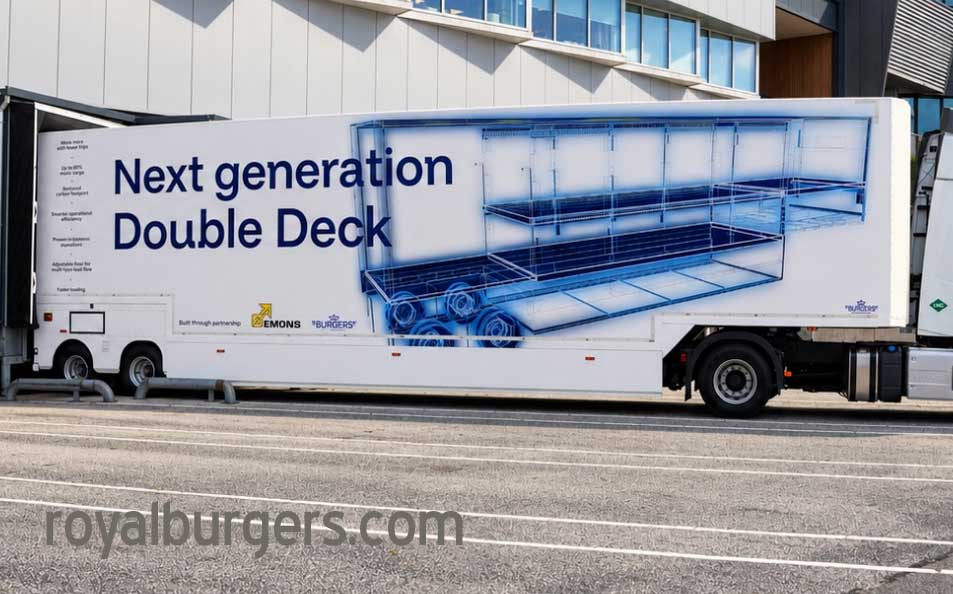
Royal Burgers and Emons present the Dock-to-Dock double-deck trailer. The new type of double-decker was unveiled at IAA Transportation in Hanover.
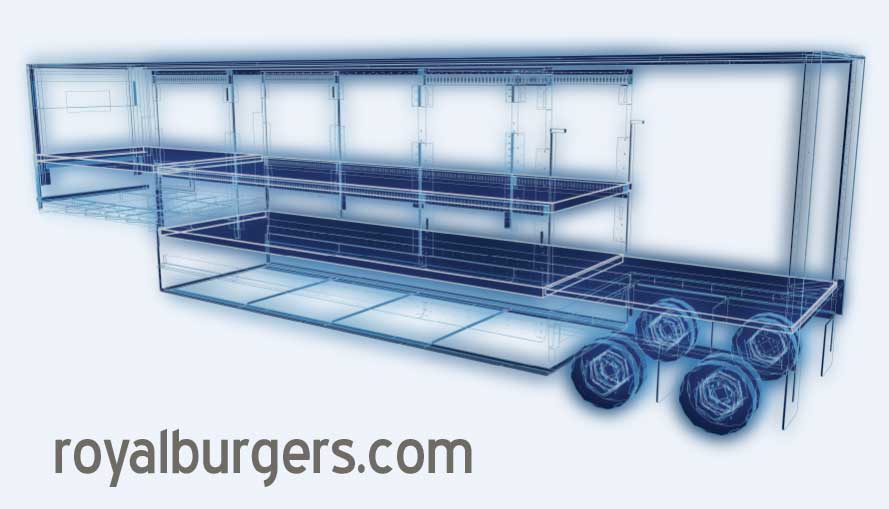
Royal Burgers and the Emons Group present the new Dock-to-Dock double-deck trailer, which was unveiled at IAA Hanover (September 2026). The trailer represents a further evolution of an already successful high-capacity FTL (Full Truck Load) concept designed for pallet transport between warehouses. Royal Burgers and Emons developed this trailer jointly. The Burgers Dock-to-Dock combines a hydraulically movable floor system (in three sections) with a “smart steering system.”
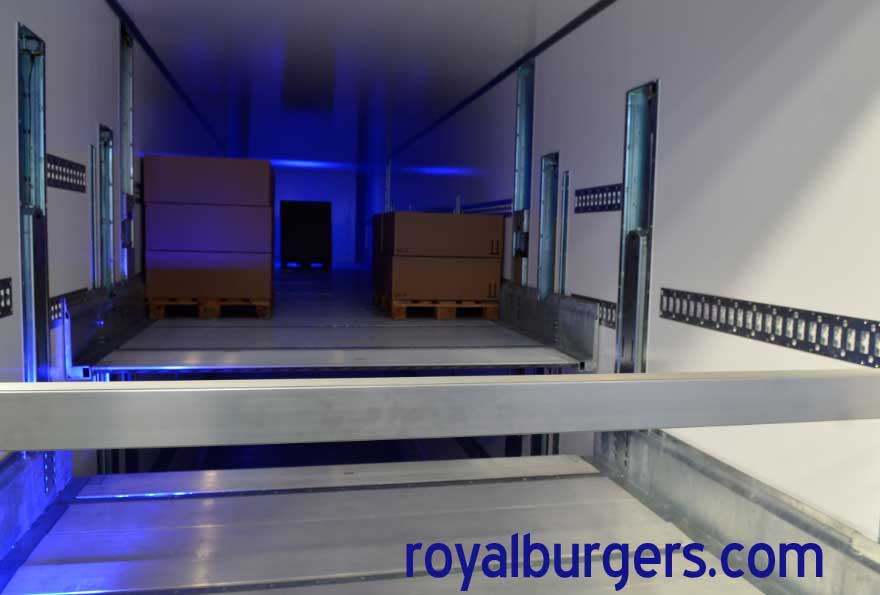
The loading process begins with the hydraulically adjustable floor in the central, lowered section—the “belly”—of the trailer. The floor is first raised to align with the loading dock, allowing the first 18 pallets to be loaded directly. Subsequently, the entire floor, including the cargo, is lowered to the position within the trailer’s belly.
Next, a short-stroke lift at the rear moves in a controlled manner between the loading dock level and the upper deck. Through these repeated short movements, 28 pallets are transferred from the loading dock to the upper deck. Once these pallets are loaded, the lift returns to the level of the floor and the loading dock. The final 6 pallets are then loaded directly onto the rear floor section; the lift remains stationary during this last step. This results in a total loading configuration of 18 + 28 + 6 = 52 pallets with a maximum height of approximately 180 cm.
The trailer can also be used for higher-loaded pallets. The middle load deck can be positioned to provide a continuous internal loading height of up to 2.50 meters. In this configuration, the trailer accommodates up to 33 conventional pallet spaces, making this Burgers trailer highly versatile.
The electro-hydraulic ‘Adaptive Steering System’ also deserves our attention. Conventional mechanical steering requires a linkage system to steer the rear axle(s). In contrast, the new Burgers system uses sensors to monitor yaw angle and speed relative to the direction of travel; this data allows it to determine the articulation angle between the tractor and trailer and calculate the required steering angle for the rear axles.
Steering of the rear axles (both are steerable) is handled by electro-hydraulic units. In addition to weight savings, this setup allows for a lower fifth-wheel height — a requirement for double-deck trailers. At higher speeds, the rear axle is locked in the straight-ahead position to ensure stability.
The result is more than just a technical advancement; it is a trailer concept designed to integrate seamlessly with logistics operations, QHES and compliance requirements, loading docks, and warehouse activities, while simultaneously boosting fleet utilization and transport efficiency.
This next generation of double-deck trailers is suitable for road, rail, and short-sea transport. Thanks to the use of an internal rather than an external tail lift, the trailer can also be deployed in EcoCombi and Super-EcoCombi (EMS2) configurations.
Royal Burgers refers to this new trailer type as the “Dock-to-Dock,” while Emons uses the designation “new generation 2WIN.” Both names refer to the same—jointly developed—type of trailer.
Royal Burgers’ traditional Double Deck trailers remain in production. They are successful in logistics operations involving transport from warehouse to store, as their external lift allows them to unload at street level.