



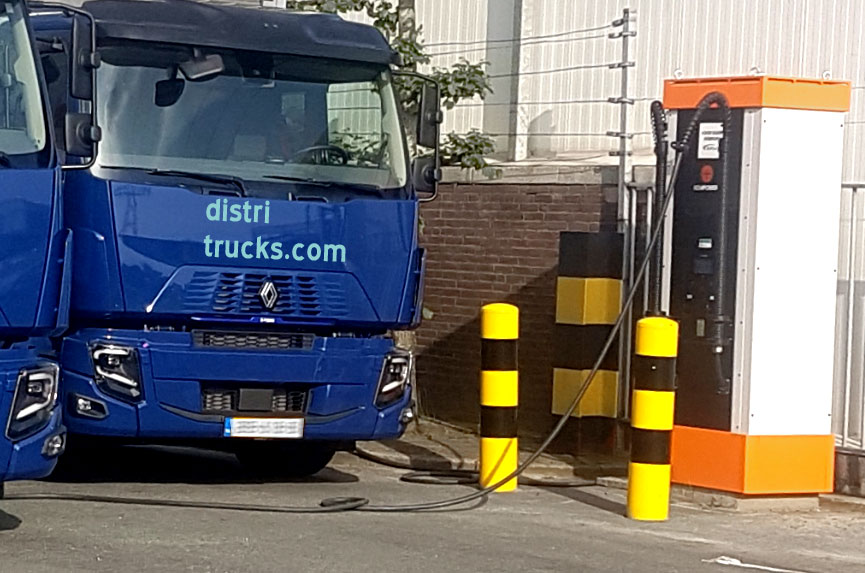
Fuel and charging costs pose the biggest challenge for fleet owners. This is shown by a study among fleet managers in Europe. With tips for transport entrepreneurs.
Fleet managers are under pressure due to rising and fluctuating mobility costs. Consequently, 64 percent of fleet managers view cost pressure as the biggest challenge, according to the DKV Mobility eMobility Study among fleet managers in Germany, Italy, France, the Netherlands, Spain, Poland, the Czech Republic, and Romania. Companies working with fuel and charging solutions primarily look for favorable prices and conditions (45%), but network and coverage (44%) and ease of use (41%) are also important.
Diesel and LNG prices are high and fluctuate enormously. Charging costs are often difficult to oversee and vary significantly by location. This makes it difficult to keep a grip on total costs and to detect deviations in a timely manner. For fleet managers with a mixed fleet (diesel/LNG and electric), the complexity is significant. Therefore, insight into costs is necessary to keep a grip on expenses. Amanda Rasch, Managing Director Benelux at DKV Mobility, offers three tips:
**Focus on total costs**
Those who only look at the visible fuel or charging price miss a part of the costs. Rates can vary enormously, especially for public charging. Additionally, roaming or peak charges may apply. Therefore, look at the total costs per vehicle, employee, and refueling or charging session. For example, monitor consumption per kilometer, chosen refueling and charging locations, charging times, and unusual transactions on a monthly basis. This allows you to see more quickly where costs are rising: due to detours, charging at expensive locations, inefficient driving behavior, or vehicles consuming more than expected.
**Make agreements with drivers**
Define which refueling and charging locations fall within the permitted network and which are preferred. Also, clarify in which situations drivers are allowed to deviate from this. Consider options such as home charging, charging during working hours, and refueling along the highway. With clear agreements, you prevent unnecessarily expensive transactions.
**Work with cost scenarios**
Work with scenarios for different price levels of diesel and kWhs. For each scenario, determine what price developments mean for total mobility costs and establish in advance the associated choices. Consider adjusting budgets, accelerating electrification, or revising lease choices. Periodically check actual costs and compare them with the scenarios. This allows you to intervene in a timely manner.