



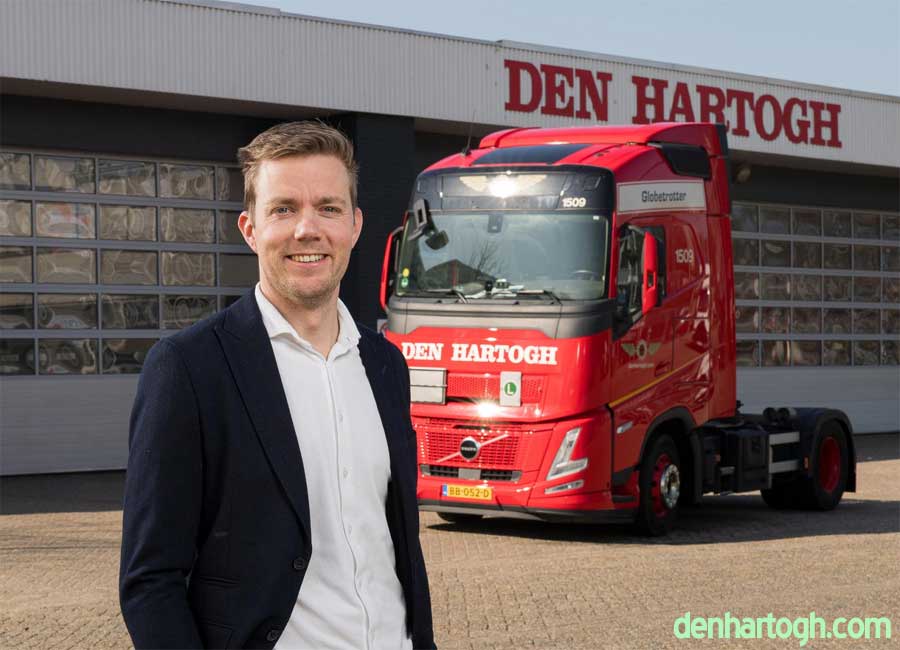
Royal Den Hartogh busy with innovations for fuel savings. Diesel savings already 8 percent following various optimizations, but it doesn’t stop there.
Royal Den Hartogh Logistics (liquid logistics, 900 vehicles, 38 branches worldwide) is achieving an 8 percent fuel consumption saving through fleet optimization. “We are working on lowering the cost per kilometer on all fronts,” says Senior Technical Manager Peter Rodenburg from the headquarters in Rotterdam. “Think of tires, engine selection, and the energy transition.” Den Hartogh is working intensively with various suppliers in this regard, such as Volvo Truck Center and tire company Continental.
To start with the latter: Continental supports Den Hartogh Logistics with tire services and Pull Point tire monitoring, including roadside assistance and cost analyses. “We are currently fitting Continental Eco HD 5 tires. These have less tread and therefore lower rolling resistance. Our experiences with them are good. They contribute to lower diesel consumption, although we cannot quantify this due to the multitude of optimizations on our trucks. Initial experiences with the Conti Eco are also positive in terms of lifespan and grip.”
Rodenburg explains that the Conti Eco tires are the “B-label.” “We could potentially go a step further with the Continental Efficiency Pro—the A-label in low rolling resistance tires—but those have less tread depth (12 instead of 15 mm) and therefore require replacement sooner. We do not think that outweighs the additional fuel savings.” Thus, Den Hartogh is constantly weighing costs against efficiency. Does the VECTO value play a decisive role in this regard in relation to toll rates? “We want to operate our trucks in VECTO Class 3. But the savings lie not so much in the toll reduction as in lower diesel consumption,” Rodenburg explains.
We almost naturally arrive at the topic of electrification – in other words, zero diesel. Den Hartogh operates five electric Volvo tractor units. That sounds cautious in such a massive fleet. Rodenburg: “That is correct. The transition to zero emissions is going to happen anyway, but we don’t know at what pace. Liquid logistics is a kilo business. That is where the bottleneck lies. We find electric trucks very interesting, but we need more capacity on the fifth wheel. We are certainly going to look at those new Volvo FHe 6×2 tractor units. We might also be able to make adjustments to our container chassis, for example by placing the container further back. That, too, has its limitations, because we want to fully utilize the axle loads of the complete combinations.”
“One thing is certain. Energy is becoming increasingly expensive. That is why we must handle it as efficiently as possible. We will continue to innovate in the coming years.”