



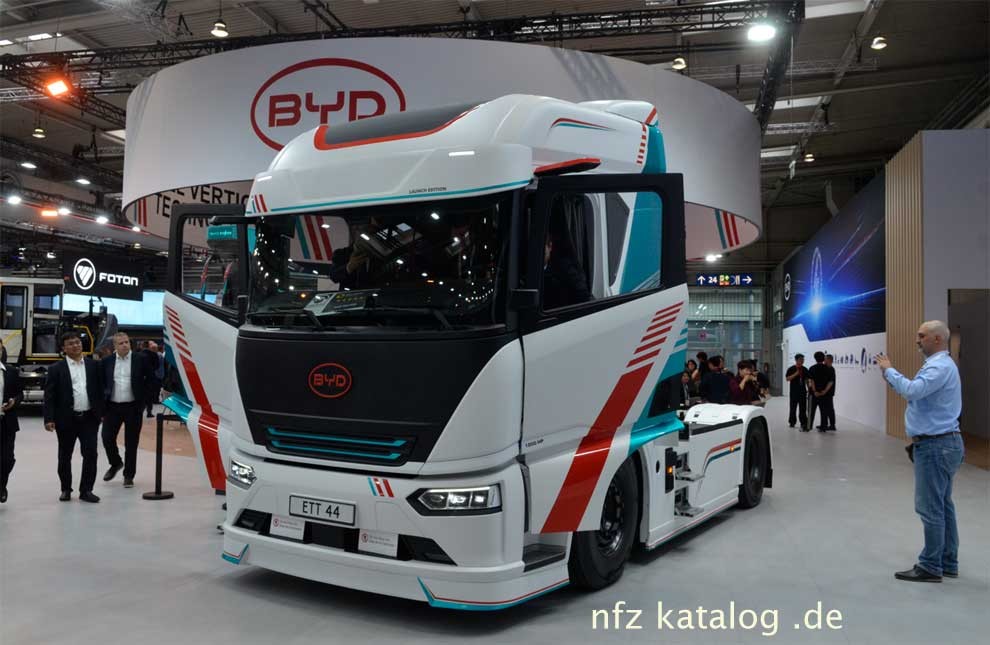
The Chinese are here, with trucks and impressive exhibition stands. But beyond that—nothing. There are launches of low-cost Chinese trucks, yet the entire supporting ecosystem is missing.
We predicted it before the IAA exhibition began: the truck market would be flooded with new Chinese vehicles.
That prediction came true.
And the scale is even greater than we anticipated. New truck brands—completely unknown in Europe—are presenting themselves to the European market. They range from small vans to heavy-duty trucks boasting over 1,000 hp.
We were already familiar with DongFeng and Sitrak. Superpanther had announced its arrival, too. Those who follow international media might also have heard of FAW Trucks and Foton.
But Skyworth? GAC? CNCTrucks? Wisdom Motors? Deepway? These names are totally unknown on our continent—yet here they are, occupying massive stands at the IAA trade fair in Hanover. They are showcasing futuristic electric trucks—some looking as if they drove straight out of a comic book—with boundless optimism.
European truck manufacturers, by contrast, are facing a tough situation. They are investing in new electric trucks and the necessary infrastructure: networks of trained mechanics, new spare parts, and adapted workshops across Europe. They are providing consultancy for diesel customers looking to go green and setting up charging hubs for transport operators. They are retooling their production lines. In short, they are making massive investments to facilitate the transition to zero-emission transport.
Transport operators are hesitant to invest; they are waiting to see how things unfold. Will it be a few more years of diesel, battery-electric trucks, or perhaps hydrogen? Meanwhile, diesel prices are skyrocketing, and operators are unable to pass on (or fully pass on) the rising toll costs. The Chinese invasion is causing frustration among EU truck brands. “They haven’t sold a single vehicle yet, but they present themselves as if they were the market leader,” says a spokesperson for a European truck brand. “For years, we’ve seen Asians here taking photos of every detail of our trucks. It’s not against the rules, but it comes across as disrespectful. Then they introduce models that look a lot like ours.”
A truck blogger notes: “I’m very curious to see how this plays out. The Europeans are terrified. We’re walking around Hannover, but it feels like Beijing. The Chinese are selling everything related to electric transport—from a tiny switch to complete electric chassis that a manufacturer can build their own truck around. This is simply a new era.”
An employee of a Chinese manufacturer admits that the brand sold only one truck in Europe last year. “But in China, you see our vehicles everywhere. And now we’re going global. Do you know why our trucks are so cheap? Production is done by robots. In Europe, a lot of work is still done by hand.”
Yet, there are also optimistic voices among the Europeans. A PR representative for a major manufacturer says: “The Chinese might be cheaper, but ultimately it comes down to the total cost of ownership. The purchase price is just one part of the total cost. A truck becomes a liability during forced downtime—when there are no mechanics or spare parts available. Chinese manufacturers have vehicles and impressive trade show stands, but nothing else. No dealers, no workshops, no spare parts, no organization. A transport operator will think twice—or ten times—before buying a Chinese truck.”