


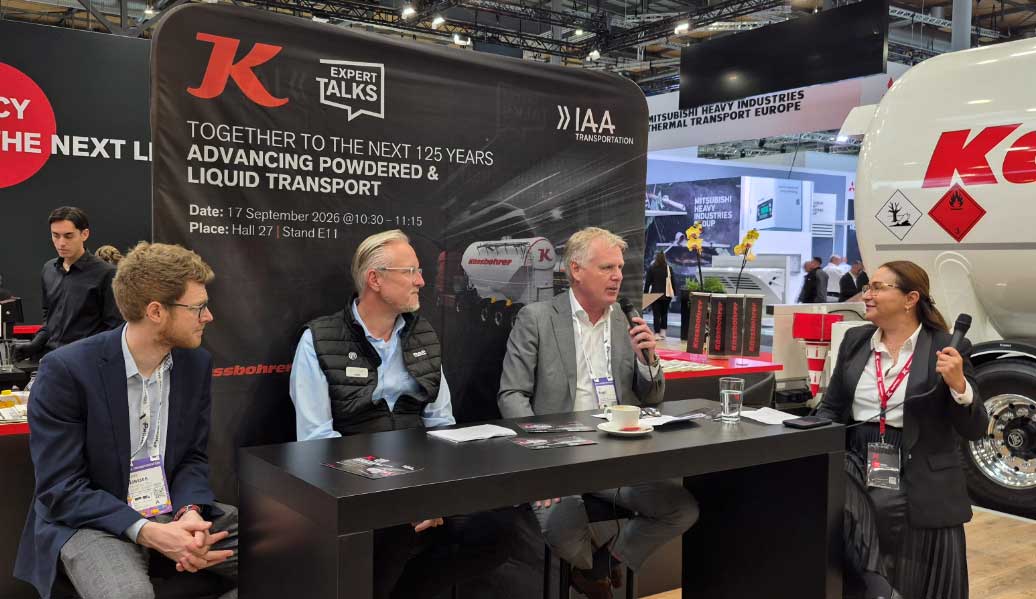
At IAA Transportation 2026, Kässbohrer hosted the second edition of its K-Expert Talk dedicated to advancing bulk liquid and dry bulk transportation. Bringing together transport operators, truck and trailer manufacturers and equipment providers, the discussion focused on the transition of specialized transport operations toward zero-emission technologies and the key factors driving large-scale deployment.
Moderated by İffet Türken, Executive Board Member of Kässbohrer, the panel explored the operational realities, technical developments and regulatory requirements shaping the future of silo and tanker transport. Members of the panel: • İffet Türken, Executive Board Member, Kässbohrer (Moderator) • Nanno Janssen, Nanno Janssen Group / Sievers Logistics • Torsten Hermsen, Zero-Emission Business Development Manager, DAF Trucks • Paul Keegel, Commercial Business Director Transport Solutions EMEIA, Ingersoll Rand Transport Solutions.
Pioneering Zero-Emission Bulk Transport Requires More Than Proven Technology
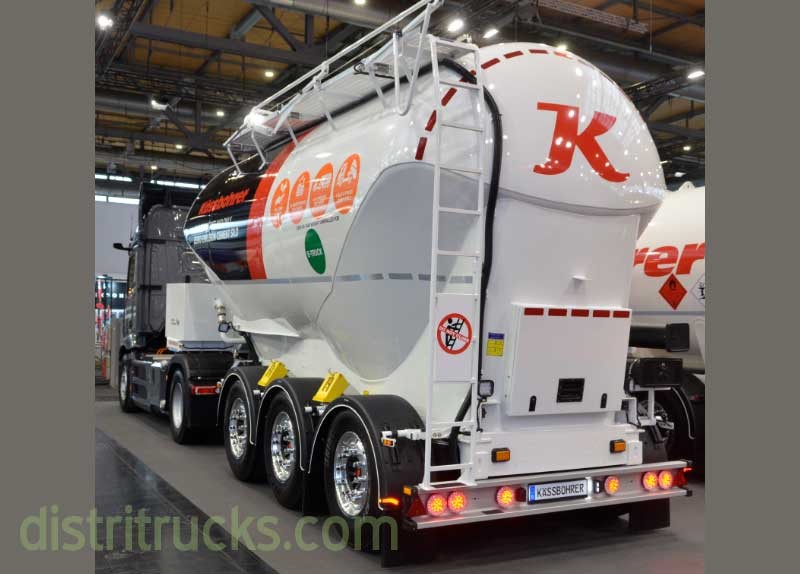
Opening the discussion, Türken emphasized the importance of collaboration across the transport ecosystem to successfully transition specialized bulk transport operations toward zero-emission technologies. She highlighted that no single stakeholder can address the challenges of electrification alone. As a practical example of the industry’s ongoing innovation, Türken referred to Kässbohrer’s latest development, a zero-emission cement silo trailer, exhibited at IAA Transportation 2026. The solution delivers 44% payload loss recovery while enabling fully electric bulk transport operations. The innovation demonstrates how collaborative engineering can help overcome some of the practical challenges in creating zero emission logistic systems.
Operators Report Positive Results from Electrification
Representing the transport operator perspective, Nanno Janssen shared practical experiences from operating a fleet of 90 vehicles, including 60 electric trucks, at Nanno Janssen Group / Sievers Logistics. Janssen explained that demand for electrified transport is growing rapidly, particularly among customers in carbon-intensive industries such as cement and construction materials. As many shippers pursue ambitious decarbonization targets, transport electrification is increasingly viewed as one of the most direct and impactful methods for reducing emissions.
He highlighted that, through optimized charging strategies and two-shift operations, electric trucks are already capable of achieving approximately 1,000 kilometers of daily utilization while delivering substantial operational savings through reduced energy costs and toll exemptions.
Janssen identifies driver training, charging infrastructure and payload management as key operational challenges still requiring industry attention.
Truck OEM Perspective: Infrastructure and Flexibility Are Key
From the vehicle manufacturer perspective, Torsten Hermsen (DAF Trucks) explained how the requirements of specialized applications such as silo and tanker transport create unique engineering challenges for electric truck design. Electric trucks must not only accommodate large battery packs but also integrate additional equipment such as compressors and hydraulic systems. This requires increasingly flexible chassis designs and close cooperation between truck manufacturers, trailer manufacturers and equipment suppliers.
Hermsen emphasized that charging infrastructure remains the single most important enabler for broader deployment. “Parking is charging,” he explained, highlighting the need for truck-compatible charging facilities that allow drivers to recharge vehicles during operational breaks. Current charging infrastructure often remains designed primarily for passenger vehicles rather than heavy-duty transport applications.
Looking ahead, he identified total cost of ownership (TCO) and infrastructure deployment as the two factors most likely to accelerate adoption. According to Hermsen, the economics of electric trucks are increasingly becoming attractive due to lower energy costs, reduced road toll expenses and emissions-related incentives.
Equipment Providers Drive Efficiency and Standardization
Discussing the technology supplier perspective, Paul Keegel (Gardner Denver) explained how electrification is transforming auxiliary transport equipment across the bulk transport industry. For compressor, pump and hydraulic system providers, the main challenge is no longer the equipment itself but the transition from conventional mechanical drives toward fully electric systems.
As electric trucks become more widespread, equipment manufacturers are focusing on:
- Compact equipment architectures
- Lower power consumption
- Reduced weight
- Greater efficiency
- Improved interoperability across truck platforms
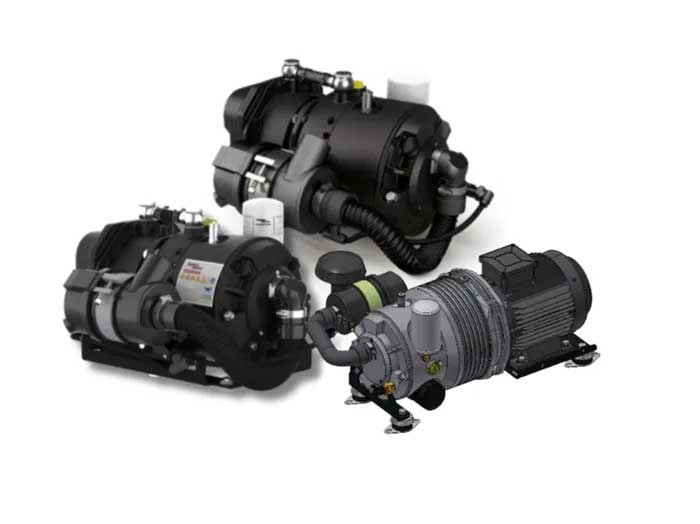
Keegel highlighted that standardization of electrical architectures will become increasingly important in supporting industry-wide adoption and reducing complexity for transport operators. He also pointed to regulatory developments related to ADR compliance for hazardous goods transport as a key area requiring further progress for liquid bulk transport applications.
Industry Consensus: Collaboration, Standardization and TCO Will Drive Scale
Throughout the discussion, three major themes consistently emerged. Infrastructure Truck-compatible charging infrastructure remains essential for large-scale adoption and operational flexibility.
Standardization
Panelists highlighted the importance of harmonization across vehicle architectures, charging systems, regulations and incentive schemes. Standardization is expected to accelerate deployment while reducing investment risks for operators.
Total Cost of Ownership
Participants agreed that the conversation is increasingly shifting from technological feasibility to economic competitiveness. As production scales, battery technologies improve and regulatory frameworks mature, zero-emission transport is expected to become increasingly attractive from a business perspective.
From Demonstration to Profitable Deployment Closing the discussion, İffet Türken summarized the industry’s current position. The focus is no longer primarily on proving the feasibility of zero-emission technologies. Instead, the conversation has evolved toward scalability, profitability, standardization and collaboration. She emphasized that the transition to zero-emission transport is fundamentally a system challenge that requires coordinated action from vehicle manufacturers, trailer manufacturers, technology suppliers, transport operators and policymakers alike.
Through K-Expert Talk, Kässbohrer continues to bring together stakeholders across the value chain and support the industry’s transition towards more competitive, efficient and sustainable transport solutions.